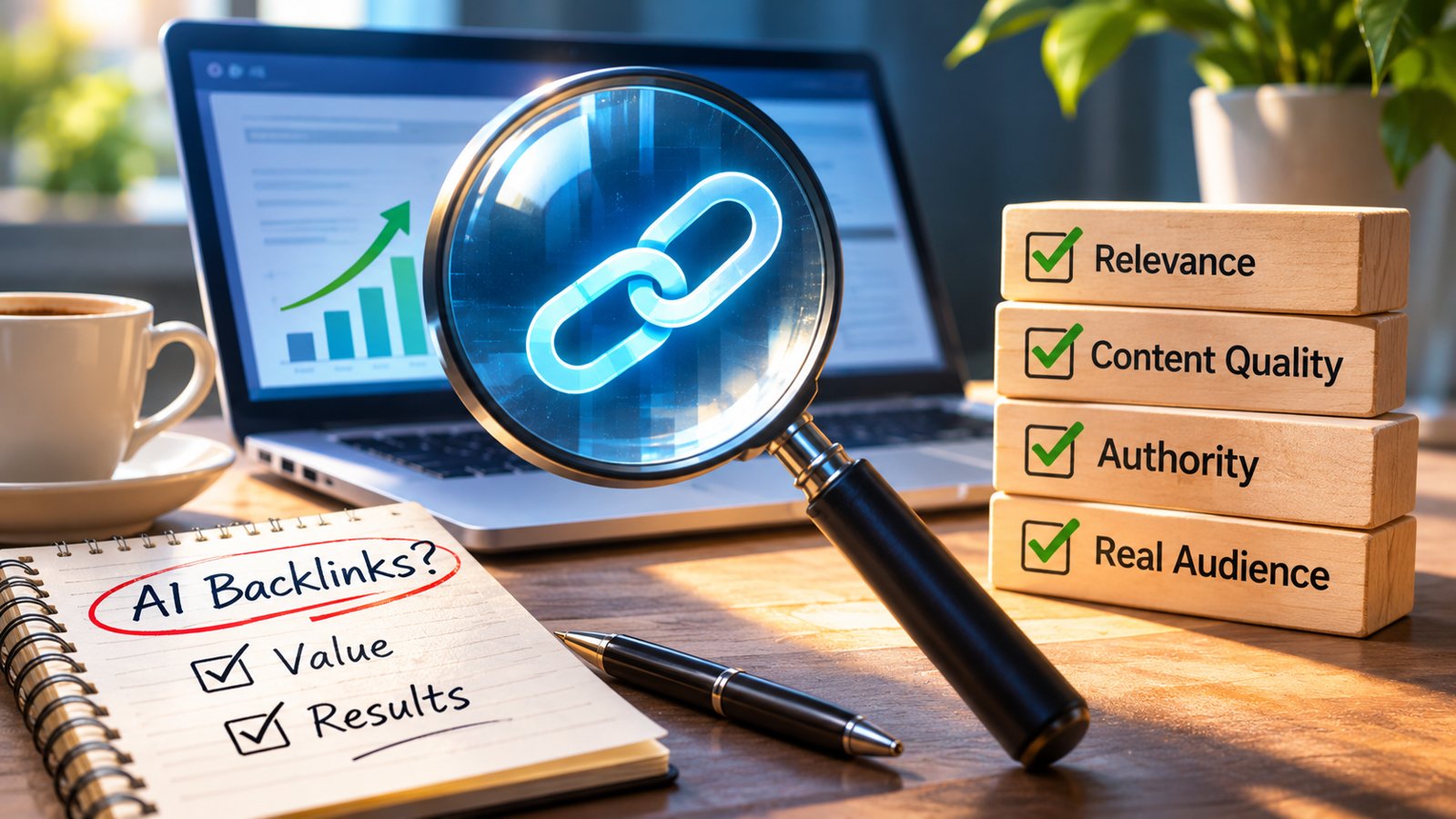
A thousand backlinks in a matter of days. Automated article creation. Website authority without endless negotiations with publishers. The promises surrounding AI backlinks sound almost too good to be true.
But behind the impressive numbers lies a more interesting question: does artificial intelligence actually change the value of a backlink, or does it simply change the way businesses acquire one?
The answer is worth exploring, especially for companies investing in search engine optimization and looking for new ways to become visible in generative AI search results.
Not every automated backlink is valuable. Equally, not every manually acquired backlink deserves its price tag.
What Exactly Are AI Backlinks?
AI backlinks are external links acquired through processes that use artificial intelligence to assist with content creation, publishing opportunities, campaign organization, or website selection.
The backlink itself is not fundamentally different from a traditional link. It still connects one website to another.
What changes is the process behind it.
Instead of spending hours researching publishers and preparing individual articles, marketers can use technology to simplify these activities. Some platforms combine AI-assisted writing with extensive publishing networks, allowing businesses to organize entire campaigns from a single interface.
This technology has made external content publishing more accessible. However, accessibility should not be mistaken for automatic effectiveness.
The Experiment: Two Backlinks, Two Very Different Stories
Consider a hypothetical business selling ergonomic office chairs.
The company acquires two external publications.
The first appears on a website discussing workplace productivity. The article explains how office furniture affects comfort during long working days and includes a relevant link to the company's product range.
The second publication appears on an unrelated website filled with generic articles covering everything from gardening to cryptocurrency. Its content offers little practical information, and the backlink feels forced.
Both publications were prepared with the assistance of artificial intelligence.
Both contain backlinks.
Yet their potential value is clearly different.
The first provides context, addresses a recognizable customer need, and introduces the business to a potentially relevant audience. The second exists primarily to create another link.
This example illustrates why evaluating AI backlinks solely by their quantity makes little sense.
Myth Number One: AI-Generated Content Automatically Means Poor Quality
Artificial intelligence has developed a somewhat complicated reputation among content professionals.
Some associate it with repetitive articles, awkward sentences, and information that lacks depth. Those concerns are understandable. Poorly configured AI tools can produce exactly that kind of material.
However, human-written content can suffer from the same problems.
The quality of an article depends on its purpose, accuracy, structure, originality, and usefulness to the reader. The method used to prepare it is only one part of the equation.
Effective AI link building should involve clear editorial direction, meaningful topics, and relevant information rather than simply generating hundreds of nearly identical articles.
A useful test is straightforward: would the article still deserve to be published if its backlink were removed?
If the answer is yes, the content is probably moving in the right direction.
Myth Number Two: More Backlinks Always Mean Better Results
Imagine purchasing a thousand business cards and distributing them randomly across an entire city.
Now imagine handing fifty business cards to people who are actively interested in your services.
Which approach is more likely to generate meaningful attention?
Backlink campaigns involve a similar principle.
Domain relevance, editorial context, audience suitability, and publishing standards deserve consideration alongside numerical metrics.
A business should evaluate potential publications according to several criteria:
• Does the publication address a topic related to the company's products or services?
• Does the website contain useful and accessible content?
• Is the backlink incorporated naturally into the article?
• Does the publication offer genuine value to its readers?
• Are commercial relationships and paid links appropriately identified?
The availability of automated backlink generation makes these questions more important, not less.
Where Can Businesses Manage AI Backlink Campaigns?
Companies interested in combining artificial intelligence with external article publications can consider platforms such as Bzoomer.
The platform combines AI-assisted content creation, publishing opportunities, campaign management, and recurring SEO activities through its Autopilot functionality.
With a marketplace containing more than 50,000 websites, it offers businesses an alternative to searching for and coordinating individual publishers manually.
For smaller businesses, the appeal is understandable. Managing external publications can become expensive and time-consuming, particularly when targeting multiple markets.
Marketing agencies may also benefit from organizing several campaigns within one platform.
When choosing a provider of AI backlinks, customers should consider transparency, publication relevance, flexibility, reporting capabilities, and the opportunity to review completed work.
The number of promised links should never be the only deciding factor.
The Connection Between Backlinks and AI Recommendations
A few years ago, most businesses concentrated almost exclusively on Google rankings. Today, the picture is considerably more complex.
Potential customers ask ChatGPT for product recommendations. They use Gemini to explore purchasing options and turn to Perplexity when researching unfamiliar services.
A user might ask:
“Which companies provide automated SEO campaigns for small businesses?”
The resulting answer may draw upon information from multiple online sources, depending on the AI system and its browsing capabilities.
This creates an interesting opportunity for businesses.
Relevant external publications can describe a company's services, explain its specialization, and establish relationships between its brand and particular customer needs.
Well-structured articles can also provide information that is easier for search engines and AI systems to interpret.
In this context, AI SEO backlinks may support a broader strategy focused on brand discoverability rather than traditional rankings alone.
However, appearing in AI-generated recommendations is not a guaranteed consequence of acquiring backlinks. Source credibility, factual accuracy, accessibility, and the overall strength of a company's online presence remain important considerations.
How to Measure Whether Your Campaign Is Working
A growing backlink count may look encouraging in a monthly report. But does it actually translate into business results?
A more comprehensive evaluation should consider changes in organic impressions, relevant keyword positions, referral traffic, brand-related searches, and qualified website visits.
Businesses can also monitor how frequently their brand appears in responses to relevant prompts across generative AI platforms.
These observations should be recorded consistently over time. Individual AI responses may vary depending on location, wording, personalization, and available sources.
Attributing every improvement to backlinks alone would be misleading. Technical SEO, website updates, competitor activity, and market demand can also influence performance.
Frequently Asked Questions About AI Backlinks
Are AI backlinks real backlinks?
Yes. When published on an external website, an AI-assisted backlink functions as a regular hyperlink. Artificial intelligence supports the process of creating or acquiring the publication.
Can AI backlinks improve Google rankings?
Relevant editorial links can contribute to organic visibility, but outcomes vary. Paid links intended to manipulate rankings can violate search engine guidelines.
Are AI backlinks useful for small businesses?
They can help smaller businesses organize external publishing activities while reducing the time required for manual campaign administration.
Can AI backlinks help a business appear in ChatGPT recommendations?
Relevant and credible publications may contribute to online discoverability, but no backlink campaign can guarantee inclusion in AI-generated answers.
What makes an AI backlink valuable?
Topical relevance, useful surrounding content, publishing credibility, natural placement, and appropriate link attributes are important considerations.
The Verdict: Technology Is Not the Problem
Artificial intelligence has changed how businesses approach content creation and digital publishing. It has removed many administrative barriers and made external publication campaigns easier to organize.
But the fundamental principles have not changed.
A relevant article is still more meaningful than an irrelevant one. Useful information is still preferable to empty marketing language. Credibility still matters.
The real opportunity behind AI backlinks is not the ability to produce endless links. It is the ability to develop a more consistent, thoughtful, and recognizable online presence without unnecessary manual work.
Technology can accelerate the process. Strategy determines whether that acceleration takes your business in the right direction.